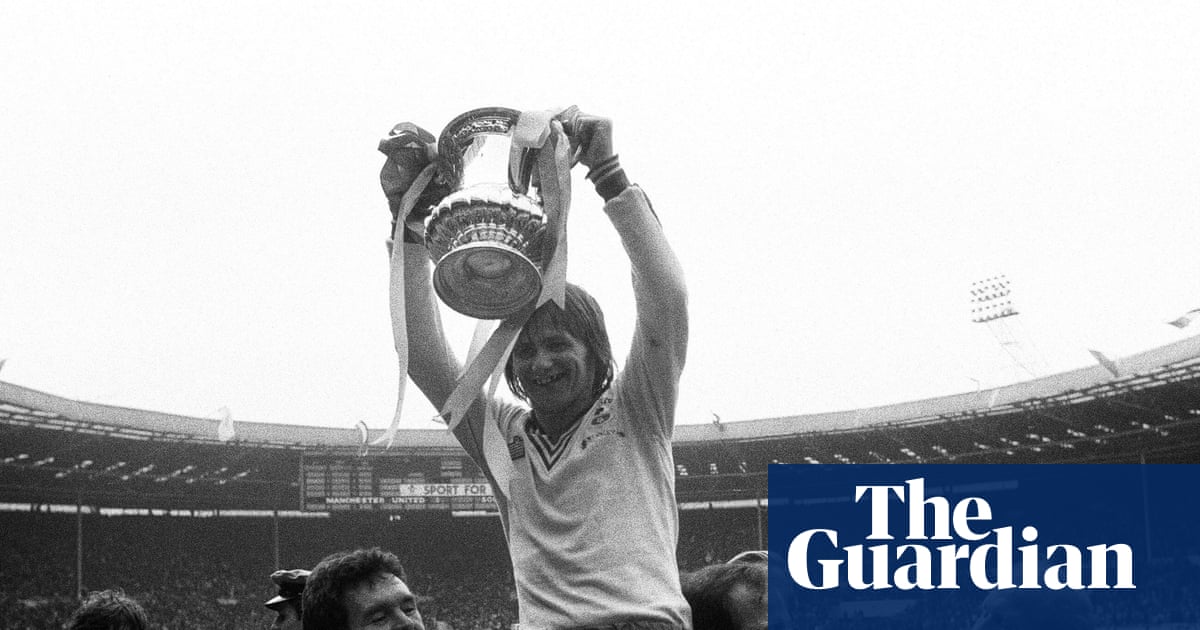
Archive, 1976: Southampton shock Manchester United to win FA Cup final – match report
Prefer the Guardian on GoogleSouthampton won the FA Cup for the simplest reasons. They were better organised in defence than Manchester United, waited more patiently for a scoring chance, and when it came took the goal with a coolness which epitomised their performance overall.
Thus, against all the odds and most of the predictions, the cup has gone to the south coast for the first time since 1939, when Portsmouth caused similar astonishment by beating the Wolverhampton Wanderers of Buckley and Cullis.
Then, as now, a team of youth and verve failed to produce their best on the day but Manchester United, unlike that Wolves side, were defeated less by their own nerve than by the nerveless approach of opponents who carried out a series of routine orders to the letter.
When Sunderland beat Leeds in the 1973 final it was the Second Division’s first Cup success for 42 years and the result was commonly judged as being “good for football.” That game robbed Saturday’s match and another Second Division victory of historical significance, and certainly the emotions of the occasion were pitched in a lower key. There were even those who felt that a win for Southampton might be bad for football because it would mean a stifling of Manchester’s ingenuity and a reaffirmation that, at the last, defensive methods brought the best rewards.
The course of the game did not bear this out. Certainly those who had come along on a sunny May Day hoping to be enthralled by a pageant of United’s talents were disappointed, but Southampton created more scoring opportunities and while their play was based on a broad defensive platform in no way could their performance be described as negative. They were, after all, a first Division side only three seasons ago and easily matched their opponents for experience at the highest level.
Nevertheless, something had died in Tommy Docherty’s team since the semi-finals. The spark that had touched-off an explosion of attacks against Derby County at Hillsborough was rarely ignited.
The match began with Coppell slipping past Peach on the right and poor Turner, in Southampton’s goal, all digital disarray as he parried, fumbled and grabbed at catchable balls. But in the space of six minutes United were caught offside four times and after that their attacks became circumspect. It was as if, having been happily scrumping goals all season, the youngsters had been told to wait for windfalls. Southampton’s defence, gamekeepers to a man, were seldom in such trouble again and once Turner had foiled a lone break by Hill his confidence increased.
Their tactical plan was elementary but effective. The wingers, Hill and Coppell, were played tight throughout without assistance by Rodrigues and Peach; Holmes stayed goal side of Daly, denying the Irishman space and forcing him to play the ball short and safe; Macari, lying deep, found his avenues to the wings blocked by Gilchrist and McCalliog and when possession was lost Osgood and Channon were often to be found making important tackles near their own goalline.
Steele won the most crucial battle of all. Not many centre-backs this season have been able to stop Pearson turning on the ball but the Scot achieved it and did moreover without resorting to foul play. With Blyth diligently covering the threat of Mcllroy, which never really materialised, Manchester, though they whittled away at the wings, never carved open the centre of Southampton’s defence.
The nearest they came to scoring was on the hour, when Pearson headed on Hill’s corner from the near post and Mcllroy, getting up well, nodded the ball against the bar.
But another movement, when Pearson accepted a return pass from Coppell at top speed and volleyed the ball wide, was more typical of United’s style – the titbit that replaced the feast.
Southampton did Manchester the courtesy of announcing, just past the half-hour, how they intended to win the match. A lobbed through ball from McCalliog dropped into the path of Channon who, like Eusebio in the 1968 European Cup final, had only Stepney to beat although he was a little further out.
Stepney saved in the manner born but if United had noted the warning they showed little sign of heeding it when, in the second half, McCalliog’s passes began to find Channon once more in space and often out of Buchan’s reach.
This sort of attack is easily baulked by the use of a sweeper, but sweepers are not United’s style.
In the last half-hour it became increasingly obvious that the first goal would be the winner and increasingly likely that Southampton would score it.
In the 84th minute Channon, lurking wide on the right met a goal kick and turned the ball inside to McCalliog – one of those unspectacular but precise sensible passes which he and Osgood had been providing all afternoon. McCalliog caught a thinly-spread United defence lying square and Stokes, a yard onside when the ball was kicked, scored much as George O’Brien might have done, without delay or fuss. Hill, the one player who might have rescued Manchester in the remaining minutes, had been replaced by McCreery some time earlier, one of their manager’s more unfathomable decisions.
There were tears from some of their players at the end, whistles of derision from the more graceless of their supporters as Rodrigues held up the Cup, and reports that Lawrie McMenemy, the Southampton manager, had to wipe spittle from his suit after walking to the dressing room.
But Docherty accepted the defeat with a philosophy born of years of practice and, remembering his reaction to the failure of his young Chelsea team, it is possible that the most interesting stage of his career at Old Trafford is just beginning.
Southampton’s first FA Cup will be a popular success because they are one of the League’s friendliest clubs and have a chairman, George Reader (the referee of the 1950 World Cup final), who is devoted to football. Their captain, Peter Rodrigues, arrived on a free transfer from Sheffield Wednesday and to all intents and purposes had seen his best years, and Bobby Stokes nearly went to Portsmouth at Christmas. The impetus of Saturday’s victory should help the club in their drive for promotion next season and halt, for a time at least, the reports of Channon’s impending transfer.
For big McMenemy, towering over his team as benignly as the Cunarders used to look down on Southampton rooftops, a mixed experience at The Dell has reached its highest point yet. He did not spare the forecasters afterwards and certainly everybody who tipped should have known better. Saturday, after all, was All Saints Day.